Article: Best Lab Grown Diamond Tennis Bracelets to Stack in 2026
Best Lab Grown Diamond Tennis Bracelets to Stack in 2026
Lab-grown diamond tennis bracelets are the fastest-growing stacking piece for 2026, and the setting you pick decides whether it survives daily wear or ends up in a drawer after three months.
- Bezel-set lab grown diamond tennis bracelets win for daily stacking because the metal rim guards every stone.
- Classic four-prong tennis bracelets show the most light but need a clasp check every year.
- Double-row and graduated styles work better as standalone statement pieces than as stackers.
- IGI or GIA certification on every stone matters more than the setting style you choose.
- Raul Diamonds' square bezel tennis bracelet ships in 14K gold, made to order and certified.
Why this matters
A tennis bracelet lives on your wrist every day, not in a safe deposit box for special occasions. That daily contact is what separates a good stacking piece from one that scratches, gaps, or drops a stone within a year. Setting type controls durability more than carat weight does — a bezel holds a stone tighter than a shared prong ever will.
Raul Diamonds builds its lab grown diamond tennis bracelet and the rest of its collection to IGI and GIA certification standards, which matters more once you're stacking multiple pieces and need to trust every stone's grade without re-checking it yourself. For a full breakdown of what drives lab-grown diamond pricing, see the lab grown diamond engagement ring cost guide. Start on the Raul Diamonds collection page if you want to see what's in stock before reading the breakdown below.
What makes the best lab grown diamond tennis bracelet
- Setting security — bezel and channel settings protect stones from catching on clothing; prong settings show more light but need more clasp checks.
- Certification clarity — IGI or GIA paperwork should specify whether grading covers the full bracelet or a sample stone.
- Metal purity — 14K gold resists daily wear better than plated pieces; confirm karat before buying.
- Clasp type — box clasps with a safety latch outlast simple hook clasps for daily stacking.
- Stack compatibility — a bracelet's thickness and link style determine whether it sits flat against other pieces or fights for wrist space.
- Price transparency — per-carat pricing should be listed or available on request, not buried behind a "call for quote."
Lab grown diamond tennis bracelets at a glance
| Style | Best for | Standout feature | Key limitation |
|---|---|---|---|
| Bezel-set | Everyday stacking | Metal rim guards each stone | Slightly less light than open prongs |
| Classic four-prong | First tennis bracelet | Maximum sparkle, minimal metal | Prongs snag on knit sleeves |
| Double-row | Solo statement wear | Higher total carat weight per inch | Too thick to stack under most rings |
| Graduated | Pairing with delicate chains | Center stones taper toward the clasp | Harder to resize evenly |
| Fancy-shape link | Pairing with a fancy-shape ring | Oval or emerald links echo a matching ring | Fewer stock sizes available |
| Two-tone / alternating metal | Mixed-metal stackers | Works with yellow and white gold together | Harder to match if you add pieces later |
1. Bezel-set tennis bracelet: best lab grown diamond tennis bracelet for everyday stacking
A bezel-set tennis bracelet surrounds each stone in a thin metal rim instead of holding it with open prongs, which is why it takes a direct hit from a desk edge or car door without chipping a girdle. Raul Diamonds' square bezel tennis bracelet sets square lab-grown diamonds in 14K gold, made to order rather than pulled from stock.
Square bezel tennis bracelet pros:
- Full metal coverage protects stones from chips and snags
- Reads as more modern than a classic prong tennis bracelet
- Made to order in 14K gold with certified lab-grown diamonds
- Sits close to the wrist, so it layers under a cuff without catching
Square bezel tennis bracelet cons:
- Bezel settings show slightly less light through the sides of each stone than an open prong
- Made-to-order production means it's not a same-week purchase
- Square-cut stones read more geometric than round brilliants
Square bezel tennis bracelet pricing: check current pricing on the product page — 14K gold and certified stones price per carat and per stone count.
Best for: buyers who want one tennis bracelet to wear every day without babying it. Verdict: Buy.
2. Classic four-prong tennis bracelet: best for a first tennis bracelet
Four-prong tennis bracelets hold each stone with minimal metal, which is why it's the style most people picture first. Open prongs let light hit each stone from more angles, so a lower carat weight can still look bright.
Pros:
- Maximum light return per carat
- Widely available, so comparison shopping is easy
- Classic look pairs with any other jewelry already in a stack
Cons:
- Prongs catch on sweaters, gloves, and seatbelts more than bezel settings
- Needs periodic tightening checks to avoid losing a stone
- Less distinctive than bezel or fancy-link styles
Best for: a first tennis bracelet where classic styling matters more than daily-wear toughness. Verdict: Buy, with a standing reminder to get prongs checked every 12 months.
3. Double-row tennis bracelet: best for solo statement wear
A double-row tennis bracelet doubles the stone count per inch, raising total carat weight fast without needing larger individual stones. It reads as a finished piece on its own, which is exactly the problem for stacking.
Pros:
- Higher total sparkle without oversized center stones
- Works as a standalone piece if you don't want a full stack
- Available in graduated or uniform stone sizing
Cons:
- Width usually crowds out a second bracelet on the same wrist
- Heavier per inch, so clasp strength matters more
- Cost rises fast with stone count
Best for: one bracelet that does all the work instead of stacking three thin pieces. Verdict: Hold if you're building a stack; Buy if you want a single statement piece.
4. Graduated tennis bracelet: best for pairing with delicate chains
A graduated tennis bracelet steps stone size up toward the center and back down near the clasp, borrowing the shape most people know from vintage riviera bracelets.
Pros:
- Center stones draw attention without every stone needing that size
- Slimmer near the clasp, so it tucks under a watch band or second bracelet
- Reads more vintage-inspired than a uniform row
Cons:
- Resizing evenly is harder than resizing a uniform row
- Fewer stock lengths, since placement is fixed to the pattern
- Harder to match if you want a second, identical piece later
Best for: layering with a plain gold chain where you want one clear focal point. Verdict: Buy for a mixed stack; Skip if you want uniform sparkle across the whole bracelet.
5. Fancy-shape link tennis bracelet: best for pairing with a fancy-shape engagement ring
Oval, emerald, or pear-shaped links replace the round brilliants most tennis bracelets default to, which matters if the rest of your jewelry already leans toward a fancy shape.
Pros:
- Matches an oval, pear, or emerald-cut engagement ring instead of contrasting with it
- Elongated shapes can look larger per carat than round stones of the same weight
- Distinctive against the sea of round-brilliant tennis bracelets
Cons:
- Fewer stock sizes and lengths than round-brilliant styles
- Fancy shapes show inclusions more readily, so clarity grade matters more
- Harder to resize without disrupting the shape pattern
Best for: buyers whose ring or existing pieces are already fancy-shaped. Verdict: Buy if it matches your existing pieces; Wait if you're still deciding on a ring shape.
6. Two-tone or alternating metal tennis bracelet: best for mixed-metal stackers
Alternating yellow and white gold links solve the problem of a wrist that already mixes both metals in rotation.
Pros:
- Works with yellow gold and white gold pieces without clashing
- Reads less "matchy" than a single-tone stack
- Flexible enough to anchor future additions in either metal
Cons:
- Two-tone pieces are less common, so selection is narrower
- Harder to match exactly if you add a third bracelet later
- Resale value on mixed-metal pieces is less predictable than single-tone gold
Best for: buyers who already mix yellow and white gold. Verdict: Buy if your stack is already mixed-metal; Skip if you're building a single-tone gold stack from scratch.
How we ranked these lab grown diamond tennis bracelet styles
Every style above gets judged against the same six criteria: setting security, certification clarity, metal purity, clasp durability, stack compatibility, and price transparency. Bezel-set and four-prong styles rank higher for stacking specifically because they sit flat against a second or third piece; double-row and statement styles rank lower for stacking because width works against them, not because the craftsmanship is worse.
“A bezel doesn't outshine a prong setting — it just outlasts it.”
Build the full stack
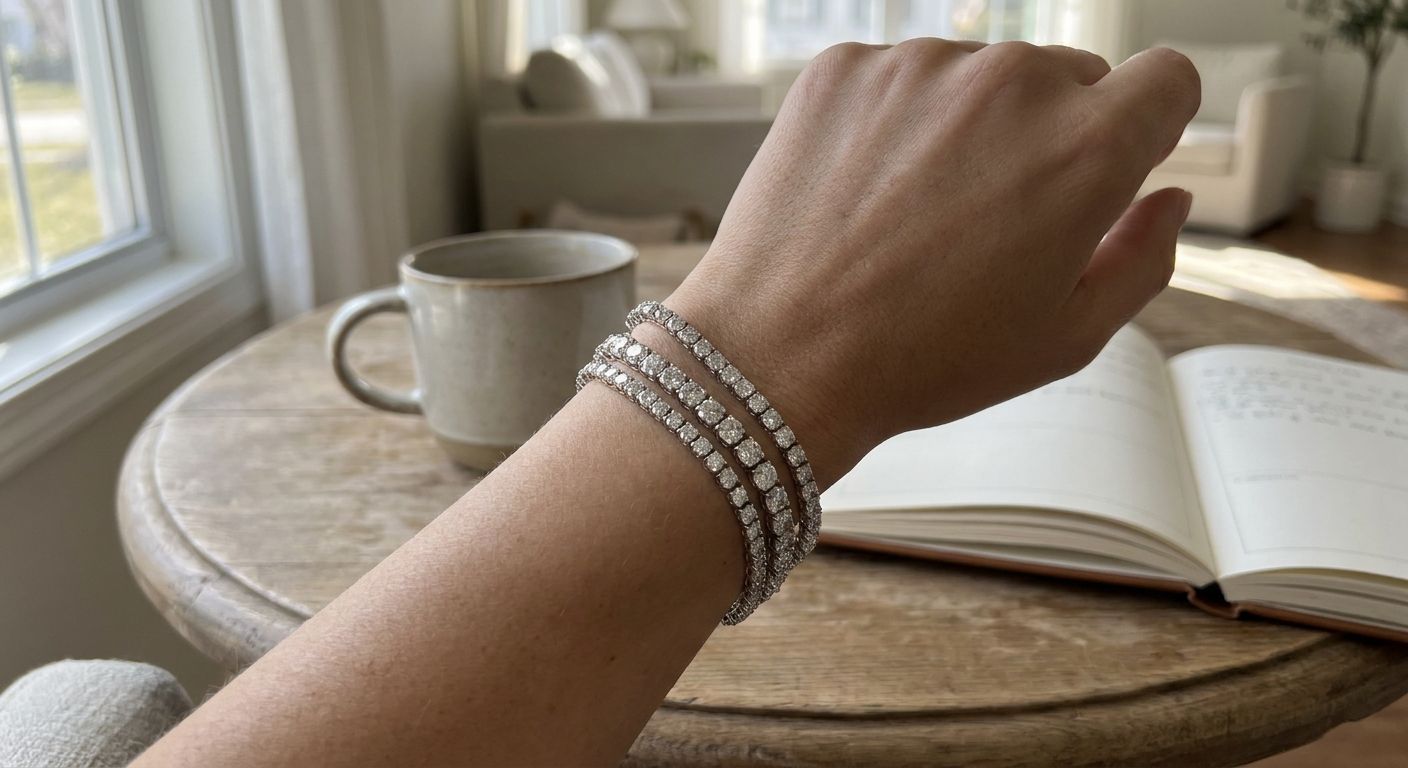
A lab grown diamond tennis bracelet rarely stays alone on the wrist past the first few months of 2026. Pairing it with a plain gold chain or a small charm piece keeps the tennis bracelet as the focal point instead of competing with a second diamond piece for attention.


Which lab grown diamond tennis bracelet should you choose?
Default to the bezel-set style if you're stacking daily and don't want to think about prong checks. Raul Diamonds' square bezel tennis bracelet already made that trade-off: full metal coverage, 14K gold, certified stones ready to wear in 2026.
If sparkle matters more than snag-resistance, the classic four-prong is the safer classic pick, provided you get the prongs checked yearly. Everyone else should match style to what's already in the jewelry box — fancy-shape links next to a fancy-shape ring, two-tone next to a mixed-metal stack, graduated next to a plain chain.
FAQ
What's the best lab grown diamond tennis bracelet for everyday wear in 2026?
A bezel-set lab grown diamond tennis bracelet is the best pick for everyday wear in 2026 because the metal rim protects each stone from chips and snags. Prong-set styles show more sparkle but need more upkeep for daily use.
Is a lab grown diamond tennis bracelet as durable as a natural diamond one?
Yes — lab-grown diamonds share the same hardness and durability as mined diamonds. Durability differences between tennis bracelets come from the setting style and metal purity, not the diamond's origin.
Should a tennis bracelet be IGI or GIA certified?
Both IGI and GIA are credible labs, and IGI grades most lab-grown diamonds on the market today. What matters is whether the certification covers every stone in the bracelet or just a sample.
Can I wear a lab grown diamond tennis bracelet every day?
Yes, especially in a bezel or channel setting that guards each stone. Prong-set bracelets can also be worn daily but need a clasp and prong check roughly once a year.
What's the difference between a bezel-set and prong-set tennis bracelet?
A bezel-set bracelet wraps each stone in a metal rim for protection, while a prong-set bracelet uses open metal claws that let in more light. Bezel wins on durability; prong wins on sparkle.
How do I stack a tennis bracelet with other bracelets?
Keep the tennis bracelet as the focal piece and pair it with a slimmer chain or charm bracelet rather than a second diamond piece. Matching metal tone (yellow or white gold) keeps the stack looking intentional.
Does a lab grown diamond tennis bracelet hold value?
Value depends more on metal purity and certification than on whether the diamond is lab-grown or mined. Single-tone 14K gold pieces with full certification tend to hold value better than mixed-metal or uncertified pieces.
How much does a lab grown diamond tennis bracelet cost in 2026?
Pricing depends on carat weight, stone count, and setting style, and is best checked directly on the product page rather than estimated. Bezel and channel settings often cost more per carat than open-prong styles because of the added metalwork.
One last thing
Most tennis bracelet failures aren't a stone falling out — they're a worn clasp giving way first. Check the clasp, not just the prongs, every time you take the bracelet off, and you'll catch the failure point before it costs you a stone.