

The 4Cs of diamonds, made simple.
Cut, color, clarity and carat decide how a diamond looks and what it costs. Here is what each one means, and the standard every Raul center diamond meets.
Four qualities, one beautiful diamond.
Cut decides the sparkle.
Cut is the quality of a diamond’s facets: their angles, proportions, polish and symmetry. A precise cut returns light to your eye as brilliance and fire. A poor cut lets light escape, and the stone looks dull.
- Excellentor Ideal
- Very Good
- Good
- Fair
- Poor
The less color, the brighter the white.
Color is graded from D (colorless) to Z (light yellow or brown). The differences between neighboring grades are subtle, and gemologists judge them side by side under controlled light.
- D–FColorless
- G–JNear colorless
- K–MFaint
- N–RVery light
- S–ZLight
Clean to the eye, and under a loupe.
Clarity describes tiny internal features (inclusions) and surface marks (blemishes), judged under 10x magnification. At VVS, these are extremely difficult for a trained grader to see even with magnification.
- FL–IFFlawless
- VVS1–VVS2Very, very slightly included
- VS1–VS2Very slightly included
- SI1–SI2Slightly included
- I1–I3Included
Carat is weight, not size.
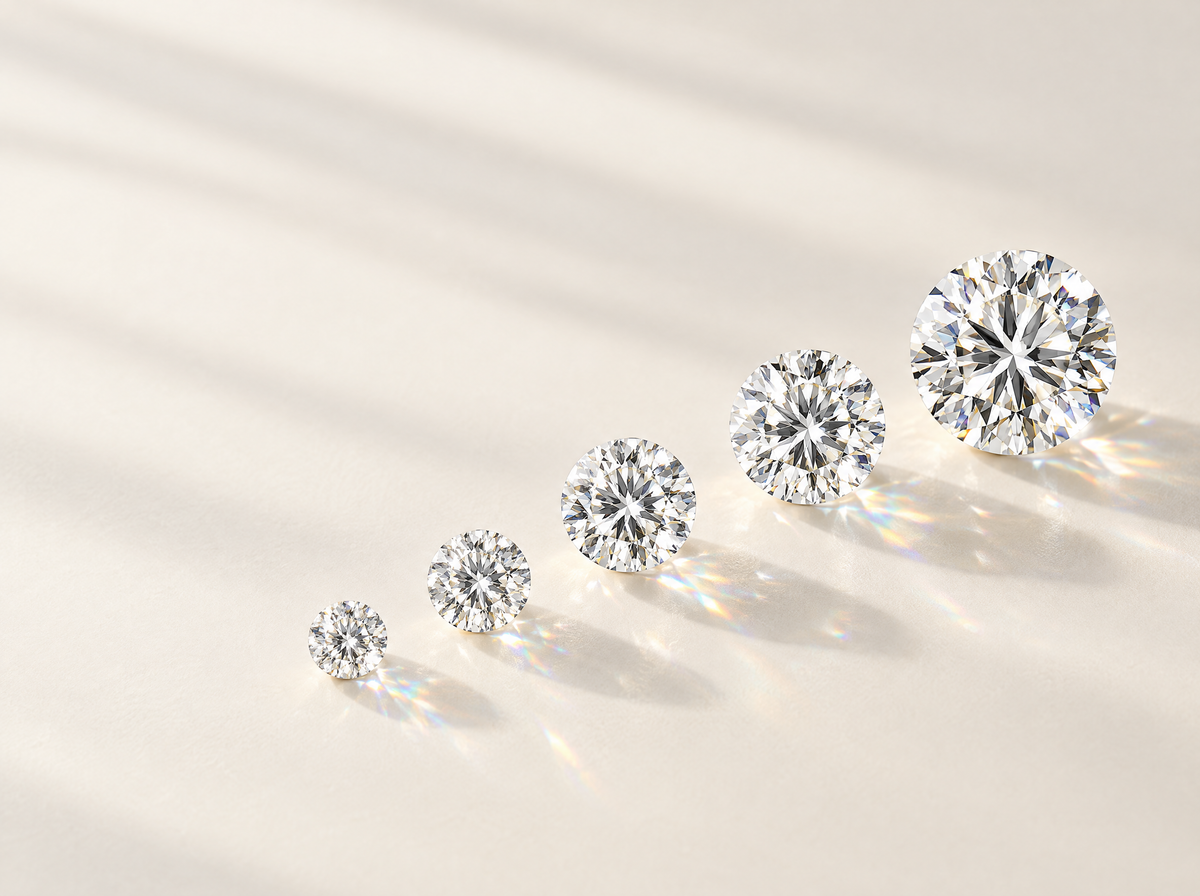
One carat equals 0.2 grams. Carat has the biggest effect on price, but how large a diamond looks also depends on its cut and shape.
| Carat weight | Round diameter |
|---|---|
| 0.50 ct | about 5.1 mm |
| 0.75 ct | about 5.8 mm |
| 1.00 ct | about 6.4 mm |
| 1.50 ct | about 7.4 mm |
| 2.00 ct | about 8.1 mm |
| 2.50 ct | about 8.7 mm |
| 3.00 ct | about 9.3 mm |
| 4.00 ct | about 10.2 mm |
| 5.00 ct | about 11.0 mm |
Approximate face-up diameter for a well-cut round brilliant. Exact size varies with proportions.
The quality is already set. You choose the rest.
Every Raul center diamond meets the same quality floor, so you can focus on the shape, size and setting you love.
| The Raul standard | What it means for you | |
|---|---|---|
| Cut | Excellent or Ideal | Maximum sparkle and light return. |
| Color | D, E or F | Colorless, bright white in any metal. |
| Clarity | VVS1 or VVS2 | Clean to the eye and under a loupe. |
| Report | Independent grading report | Every grade verified by a lab, not by us. |
About the 4Cs.
Which of the 4Cs matters most?
Cut. It decides how much light a diamond returns as sparkle, so a well-cut stone looks brighter and livelier than a poorly cut one of the same color and clarity. Every Raul center diamond is Excellent or Ideal cut.
Is a flawless diamond worth it?
For most people, no. Above VVS clarity, the differences are invisible without magnification. That is why the Raul standard is VVS1–VVS2: clean to the eye and under a loupe, without paying for a grade you cannot see.
What color grade should I choose?
D, E and F are the colorless grades, and every Raul center diamond falls within them. They look crisp in white gold and bright against yellow or rose gold.
Is carat the same as size?
No. Carat measures weight. Two diamonds of the same carat can look different in size depending on their cut and shape. Elongated shapes such as oval, pear and marquise often look larger face-up than a round of the same weight.
Is cut the same as shape?
No. Shape is the outline, such as round or oval. Cut is the quality of the facets: their angles, proportions, polish and symmetry.
Are lab-grown diamonds graded on the same 4Cs?
IGI grades lab-grown diamonds on the same cut, color, clarity and carat scales as mined diamonds. Since 2025, GIA describes lab-grown diamonds on its reports as “premium” or “standard” instead of using these scales. Compare IGI and GIA.


Find your diamond.
Talk through shape, size and budget with our team, or browse rings set with diamonds that meet the Raul standard.