

What is a lab-grown diamond?
A real diamond, grown above ground and cut by hand. Here is how lab-grown diamonds are made, how they compare to mined diamonds, and what to look for when you buy.
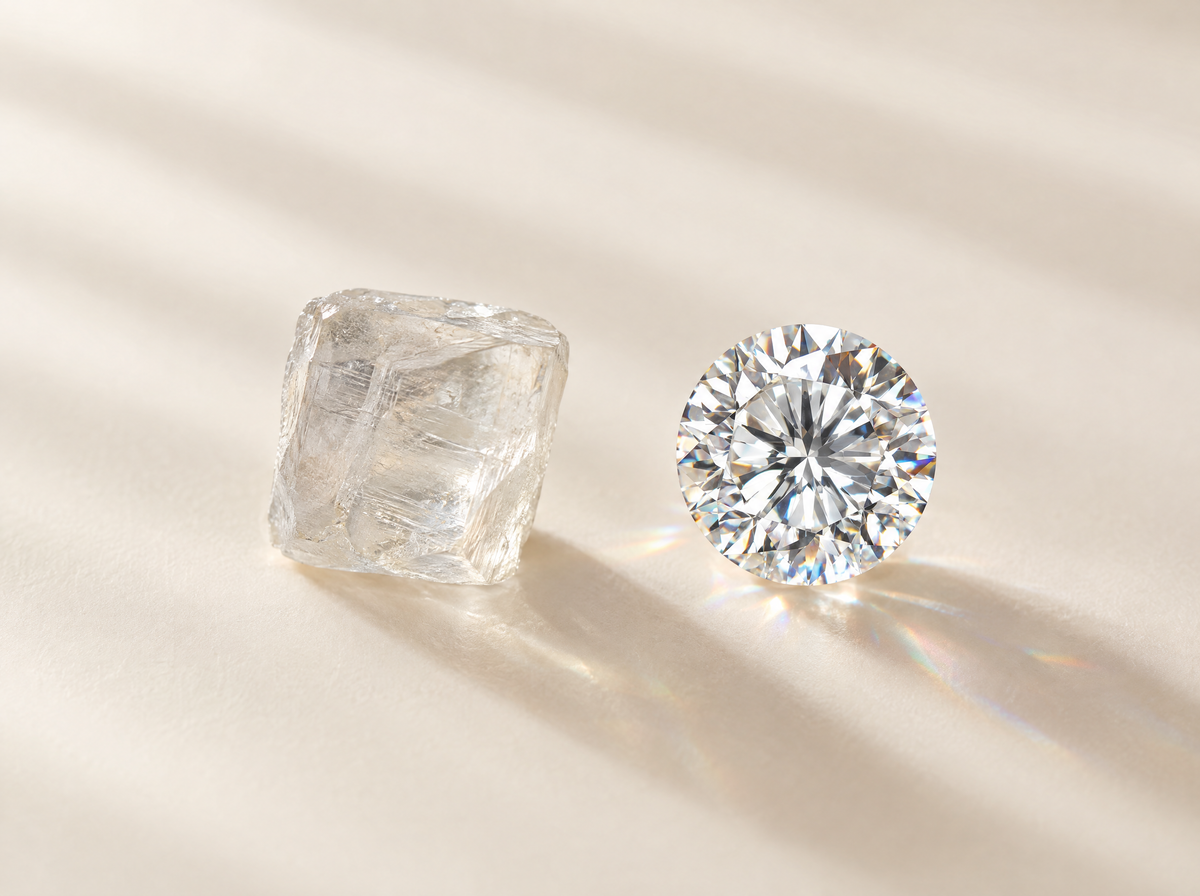
Grown by science. Finished by hand.
A diamond seed
Growth begins with a thin slice of diamond, called a seed, placed in carefully controlled conditions.
CVD or HPHT
Carbon builds up on the seed atom by atom, either from a carbon-rich gas (CVD) or under high pressure and high temperature (HPHT).
Cut, polished, graded
The rough crystal is cut and polished like any diamond, then graded by an independent lab such as IGI.
Lab-grown and mined, honestly.
| Lab-grown | Mined | |
|---|---|---|
| Material | Pure carbon | Pure carbon |
| Hardness | 10 on the Mohs scale | 10 on the Mohs scale |
| Sparkle | Same brilliance and fire | Same brilliance and fire |
| Grading | IGI grades on the 4Cs | GIA and IGI grade on the 4Cs |
| Origin | Grown in a laboratory | Mined from the earth |
| Price | Typically 50–70% less for the same grade | Higher for the same grade |
| Resale | Limited | Varies, usually below retail |
What people get wrong.
Lab-grown diamonds are fake.
Fact. They are real diamonds. Simulants such as cubic zirconia and moissanite are different materials.
You can see the difference.
Fact. Not by eye or with a loupe. Only specialist lab equipment identifies how a diamond grew.
They won’t pass a diamond tester.
Fact. Standard thermal testers read lab-grown diamonds as diamonds.
They are all the same quality.
Fact. Lab-grown diamonds vary in cut, color and clarity, which is why the grading report matters.
Three things to check.
The report
Choose a diamond with an independent grading report. IGI vs GIA.
The cut
Excellent or Ideal cut gives the most sparkle. The 4Cs, explained.
The quality floor
Every Raul center diamond is E–F color and VVS1–VVS2 clarity. The Raul Standard.
About lab-grown diamonds.
Are lab-grown diamonds real diamonds?
Yes. They are made of pure carbon with the same crystal structure, hardness and sparkle as mined diamonds. Only their origin is different.
What is a cultured diamond?
“Cultured diamond” is another name sometimes used for a lab-grown diamond. In the US, the FTC asks sellers to describe them clearly, for example as laboratory-grown or laboratory-created.
Will a lab-grown diamond pass a diamond tester?
Yes. Standard thermal diamond testers identify lab-grown diamonds as diamonds, because they conduct heat the same way.
Can a jeweler tell it’s lab-grown?
Not by eye or with a loupe. A gem lab with specialist equipment can identify the growth method, and your grading report states the origin.
Do lab-grown diamonds hold their value?
Resale value for lab-grown diamonds is limited, so choose one because you love wearing it. The benefit comes up front: a larger, higher-quality diamond for your budget.
Are lab-grown diamonds mined?
No. They are grown above ground in a laboratory, then cut and polished like any fine diamond.


See the difference for yourself.
Every Raul center diamond is lab-grown, independently graded and made to order for you.