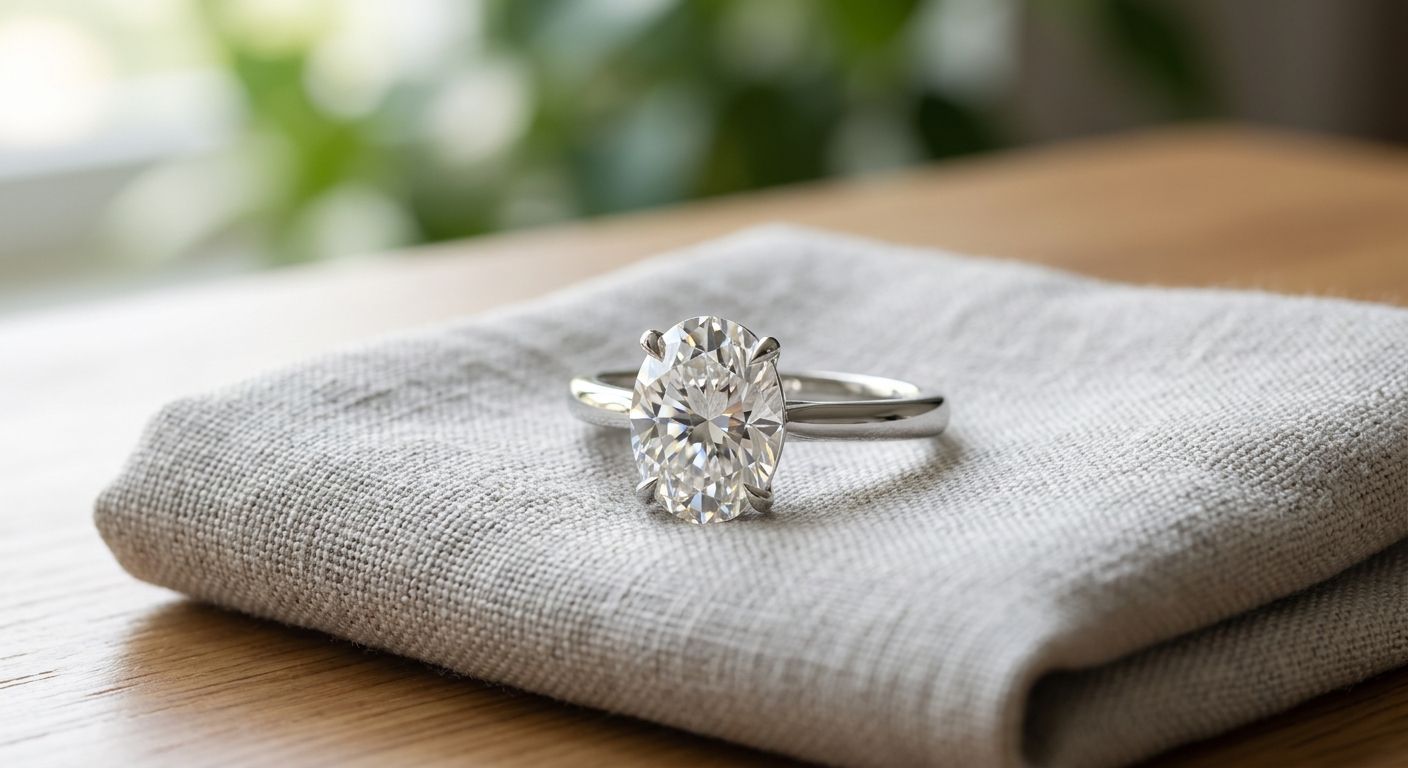
Best Oval Diamond Engagement Ring 2026: Top Picks Ranked
An oval cut lab-grown diamond engagement ring is the shape most first-time buyers land on once they see it next to a round stone — the elongated outline reads bigger per carat and stretches the finger visually. Best overall: 2ct Oval Hidden Halo Lab Diamond Ring. Best for a vintage three-stone look: Oval Three-Stone Pear Lab Diamond Ring. Best for a bold statement: Oval Three-Stone Trillion Lab Diamond Ring. Best for a minimal classic profile: a plain oval solitaire, built to order.
- 2ct Oval Hidden Halo Lab Diamond Ring is the best overall oval diamond engagement ring for 2026 — size and sparkle without extra prongs on top.
- Oval Three-Stone Pear Lab Diamond Ring wins on vintage-leaning silhouettes; the pear accents soften the classic oval bow-tie.
- Oval Three-Stone Trillion Lab Diamond Ring is the pick for a graphic, statement-heavy look with triangular side stones.
- IGI or GIA certification matters more on oval stones than round ones because inclusions and bow-tie shadowing show up faster in the elongated shape.
- Lab-grown ring prices run $1,200-$6,000 in 2026, averaging around $2,800 across styles and carat weights.
Why this matters
Oval cut stones face down the two things buyers actually worry about: apparent size and per-carat cost. Because the shape spreads surface area across a longer outline, a 1.5-carat oval reads noticeably larger than a 1.5-carat round of the same quality — you're paying for the same weight but the eye sees more diamond.
The tradeoff is the bow-tie effect, a shadow that can appear across the center of the stone depending on cut proportions. A well-cut oval controls it; a poorly cut one doesn't, and no setting fixes that after the fact. That's the one spec worth checking on a certificate before you look at anything else.
Cost still drives most decisions. Full detail on what pushes a ring toward the top or bottom of that range is in the lab-grown diamond ring cost guide — for oval specifically, expect the same $1,200-$6,000 spread, with carat weight and setting complexity doing most of the moving.
What makes the best oval cut engagement ring
- Certification — IGI or GIA paperwork on the stone, not just the setting
- Cut quality that controls bow-tie — length-to-width ratio and depth percentage stated on the cert or by the seller
- Setting security — oval stones have exposed corners; prongs need to protect them
- Metal purity — 14k gold is the standard baseline for daily wear
- Clarity grade appropriate to the shape — ovals show inclusions more readily than rounds, so VS2 or better is the safer floor
- Customization range — carat weight, band width, and metal color options at checkout
Oval cut engagement rings at a glance
| Ring | Best for | Standout feature | Key limitation |
|---|---|---|---|
| 2ct Oval Hidden Halo Lab Diamond Ring | Best overall | Hidden diamonds tucked under the halo add size with no visible extra metal on top | Underside needs regular cleaning to keep the hidden stones sparkling |
| Oval Three-Stone Pear Lab Diamond Ring | Vintage-inspired look | Pear-shaped side stones echo the oval's curve and soften bow-tie shadow | More metal and stone at the sides than a solitaire |
| Oval Three-Stone Trillion Lab Diamond Ring | Bold, statement look | Triangular trillion accents create sharp geometric contrast against the oval | Angular side stones read modern, not everyone's taste for daily wear |
| Classic oval solitaire (built to order) | Minimal, everyday profile | Nothing to distract from the center stone's cut and shape | Fewer built-in style cues if you want the ring to make a bigger visual statement |
1. 2ct Oval Hidden Halo Lab Diamond Ring: best oval cut lab-grown diamond engagement ring overall
The hidden halo places a ring of small diamonds under the head of the center stone instead of around it, so the top view stays clean while the side profile shows extra sparkle. On a 2-carat oval this adds visual weight without adding visible prongs, which is why it edges out a plain solitaire for most buyers comparing options in 2026.
2ct Oval Hidden Halo Lab Diamond Ring pros:
- Center stone reads larger from the top without extra visible metal
- Sparkle from the hidden stones catches light at angles a plain solitaire can't
- Works with most band widths and metal colors
2ct Oval Hidden Halo Lab Diamond Ring cons:
- The underside needs more frequent cleaning than an open setting
- Resizing is more involved than with a simple solitaire band
2ct Oval Hidden Halo Lab Diamond Ring pricing: check current pricing on the 2ct Oval Hidden Halo Lab Diamond Ring product page — pricing depends on the carat and metal option selected at checkout.
Best for: buyers who want maximum visual size from a single center stone. Verdict: Buy.
2. Oval Three-Stone Pear Lab Diamond Ring: best for a vintage-inspired look
This setting flanks the oval center with two pear-shaped side stones, a combination that reads more heirloom than modern. The pear accents point outward and follow the oval's natural curve, which also helps mask bow-tie shadowing at the center.
Oval Three-Stone Pear Lab Diamond Ring pros:
- Side stones visually extend the ring's length on the finger
- Pear accents soften bow-tie shadow better than round side stones do
- Reads as a complete, finished design without needing a separate wedding band stacked against it
Oval Three-Stone Pear Lab Diamond Ring cons:
- More total diamond exposure means more surfaces to catch and snag
- Pairing a plain wedding band against the pear points takes some planning
Oval Three-Stone Pear Lab Diamond Ring pricing: check current pricing on the Oval Three-Stone Pear Lab Diamond Ring product page.
Best for: buyers who want a vintage silhouette without a fully antique-style setting. Verdict: Buy.
3. Oval Three-Stone Trillion Lab Diamond Ring: best for a bold, statement look
Swap the pear side stones for trillions — triangular cuts — and the whole ring shifts from soft to graphic. The straight edges of the trillions contrast hard against the oval's curve, which is exactly the point for buyers who want the ring noticed across a room.
Oval Three-Stone Trillion Lab Diamond Ring pros:
- Sharp geometric contrast that a round or pear three-stone doesn't deliver
- Trillions catch light differently than curved stones, adding a second kind of sparkle
- Reads modern rather than traditional
Oval Three-Stone Trillion Lab Diamond Ring cons:
- The angular look isn't a fit for buyers who want something quiet for daily wear
- Trillion corners are the most exposed point on the ring and need careful prong checks over time
Oval Three-Stone Trillion Lab Diamond Ring pricing: check current pricing on the Oval Three-Stone Trillion Lab Diamond Ring product page.
Best for: buyers who want the ring to be a conversation piece, not a background detail. Verdict: Buy if the angular look fits her existing jewelry, otherwise Skip.
4. Classic oval solitaire: best for a minimal, everyday profile
A plain solitaire keeps the entire focus on the center stone's cut and proportions — no side stones, no halo, nothing competing for attention. It's the setting to pick if the priority is a ring that disappears into daily life rather than making a statement.
Classic oval solitaire pros:
- Nothing to distract from cut quality, which matters more on an oval than almost any other shape
- Lowest snag risk of the four styles here
- Easiest to resize and maintain over years of wear
Classic oval solitaire cons:
- Less apparent size than a halo setting at the same carat weight
- Fewer built-in details if the goal is a ring with visual complexity
Best for: buyers prioritizing cut quality and everyday practicality over setting details. Verdict: Buy for minimalists, Wait if you want more visual size first.
How this ranking works
The order above follows the criteria listed earlier: certification and cut control first, then setting security, then customization range. The hidden halo ranks first because it adds the most perceived size for the least added risk. The three-stone options rank next because they solve the bow-tie problem directly, and the solitaire ranks last only because it asks the buyer to do more of the size-and-sparkle work through carat weight alone.
Which oval cut engagement ring should you choose?
If you're undecided, the 2ct Oval Hidden Halo Lab Diamond Ring is the safest default for 2026 — it delivers the size gain buyers want from an oval without adding the maintenance tradeoffs of a full three-stone setting. Choose a three-stone pear or trillion version if the goal is a distinct silhouette rather than a larger-reading center stone, and go with a plain solitaire only if daily-wear simplicity outranks visual size on your priority list.
FAQ
What is the best oval cut lab-grown diamond engagement ring in 2026?
The 2ct Oval Hidden Halo Lab Diamond Ring is the best overall pick for 2026 because the hidden halo adds visual size without extra visible prongs. Three-stone pear and trillion settings are better choices if you want a distinct vintage or statement silhouette instead.
Is an oval diamond bigger than a round diamond at the same carat weight?
An oval diamond reads larger than a round diamond of the same carat weight because its elongated shape spreads surface area across a longer outline. The actual weight is identical; only the visual footprint changes.
What is bow-tie shadowing on an oval diamond?
Bow-tie shadowing is a dark band that can appear across the center of an oval or elongated diamond depending on its cut proportions. A well-proportioned cut minimizes it, and it cannot be fixed by the setting afterward.
How much does an oval diamond engagement ring cost in 2026?
Lab-grown diamond engagement rings, including oval cuts, run $1,200 to $6,000 in 2026 with an average around $2,800. Carat weight and setting complexity are the two biggest cost drivers.
Should I get IGI or GIA certification for an oval lab-grown diamond?
Either IGI or GIA certification works for an oval lab-grown diamond, and both grade cut, color, clarity and carat on the same 4 C's framework. Certification matters more on ovals than round stones because bow-tie and clarity issues show up more visibly in the elongated shape.
Is a hidden halo or three-stone setting better for an oval diamond?
A hidden halo setting adds perceived size with the least maintenance tradeoff, making it the better default choice. A three-stone setting with pear or trillion accents is the better choice if you want a distinct silhouette rather than maximum apparent size.
Does an oval cut diamond need a higher clarity grade than a round diamond?
An oval cut diamond generally needs a higher clarity grade than a round diamond of the same size because inclusions are more visible under the shape's open facets. VS2 or better is a safer floor for oval stones than for round ones.
What setting protects an oval diamond's exposed corners best?
Prong settings that wrap the pointed ends of the oval, rather than leaving them exposed, protect the stone best during daily wear. This matters most on solitaire and hidden halo styles where fewer metal points support the stone.
One last thing
The detail most buyers skip: ask for the length-to-width ratio on the certificate before you ask about carat weight. A ratio around 1.35 to 1.50 is the range most jewelers point to for a classic oval look — outside that, the stone starts reading either stubby or overly narrow regardless of how many carats it carries.