


The Raul Journal· Engagement Rings
14K vs 18K gold engagement rings: how to choose
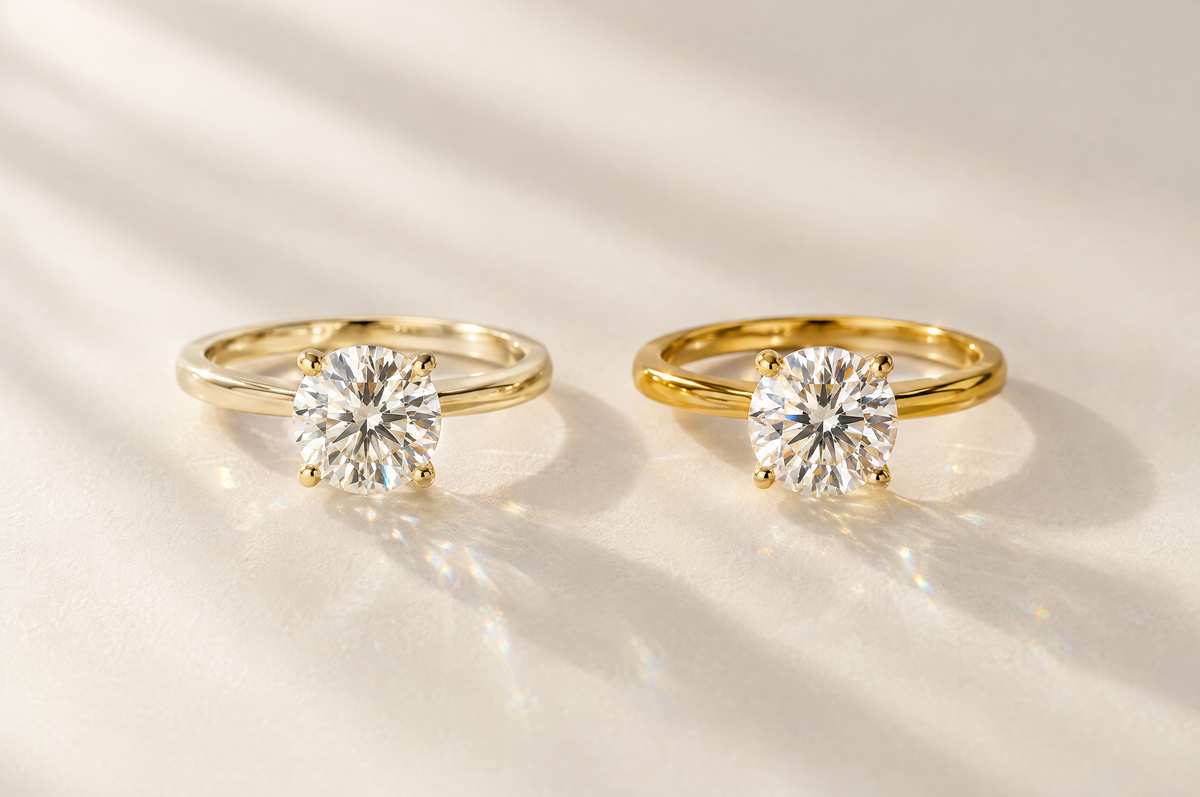
The short answer: In the 14k vs 18k gold engagement ring decision, 14K is the tougher, more affordable everyday choice, and 18K gives a richer color with more pure gold. 14K is 58.3% gold and 18K is 75% gold. In our current collection, the 18K version of the same ring typically costs a few hundred dollars more.
What the "K" means: 14K and 18K gold explained
Pure gold is 24 karat, too soft to hold a diamond securely for decades. Jewelers mix it with other metals, called alloys, to add strength and to create white and rose tones.
The karat number tells you how much of the ring is gold. 14K gold is 58.3% gold. 18K gold is 75% gold. The rest is alloy. That single difference shapes everything else in this guide: the color, the feel on the hand, how the band wears over time, and the price.
Every ring we make is available in 14K or 18K gold, in yellow, white or rose. The diamond does not change with the metal. Every Raul center diamond is Excellent or Ideal cut, E–F color and VVS1–VVS2 clarity, with an independent IGI grading report. You choose the karat for how you want the ring to look and live, not for the stone.
14k vs 18k gold engagement ring: side by side
Here is how they compare on the points that matter most.
| 14K gold | 18K gold | |
|---|---|---|
| Gold content | 58.3% | 75% |
| Hardness | Harder, more resistant to everyday knocks | Softer, shows wear a little sooner |
| Yellow gold color | Bright, lighter yellow | Deeper, richer yellow |
| White gold | Rhodium plated, crisp white finish | Rhodium plated, crisp white finish |
| Rose gold | Tends to look pinker | Tends to look softer and warmer |
| Weight on the hand | Lighter | Slightly heavier, more substantial |
| Price in our collection | Lower | Higher for the same ring |
The real price difference in our collection
We looked at every variant of our 398 engagement rings, grouped by the diamond carat you choose and the gold karat. These are our prices at the time of writing (October 2026).
| Diamond carat | 14K median price | 18K median price | Difference |
|---|---|---|---|
| 1.0 ct | $1,253 | $1,671 | $418 |
| 1.5 ct | $1,408 | $1,830 | $422 |
| 2.0 ct | $1,556 | $1,973 | $417 |
| 3.0 ct | $1,896 | $2,336 | $440 |
At 1 carat, the median 18K ring costs $418 more than the median 14K ring. At 2 carats, the gap is $417. Our lowest prices follow the same pattern: a 1 ct ring starts at $750 in 14K and $944 in 18K, and a 2 ct ring starts at $1,058 in 14K and $1,252 in 18K.
The gap comes from the metal, so it stays fairly steady in dollars as the diamond grows. In percentage terms, it matters most at smaller carat sizes, where the gold is a bigger share of the total. On a 1 ct ring, choosing 18K adds about a third to the median price. On a 3 ct ring, it adds closer to a quarter.
Designs that use more metal widen the gap further. At the top of our 2 ct range, our highest 14K price is $5,720 and our highest 18K price is $8,459.
Durability: which holds up better day to day
You wear an engagement ring every day, so hardness matters.
14K gold is harder than 18K because it carries more alloy. It resists scratches and dents better, and its prongs stay firm with less attention. If you work with your hands, garden, lift, or simply know you are hard on jewelry, 14K is the practical pick.
18K gold is softer. It still makes a fine engagement ring, and plenty of people wear it for life. It simply shows fine scratches sooner and benefits from regular prong checks.
Our lifetime warranty covers manufacturing defects, not wear, accidents, loss or theft, so a periodic prong check is worth the habit in either karat.
Color: yellow, white and rose gold in 14K and 18K
Yellow gold
This is where karat shows most. 18K yellow gold has a deep, buttery warmth that reads as classic and rich. 14K yellow gold is a lighter, brighter yellow with a more modern feel. If the warm glow of gold is the point of the ring, an 18k yellow gold engagement ring delivers it best. Browse 18K yellow gold engagement rings or 14K yellow gold to compare.
White gold
White gold is gold alloyed with white metals and then rhodium plated for a bright, cool finish. Because of the plating, 14K and 18K white gold look nearly identical when new. Over time, the rhodium wears and the warmer alloy beneath can show through. Re-plating restores the finish, often every year or two depending on wear.
A 14k white gold engagement ring is the most popular pairing with a colorless diamond, and for good reason: it is durable, bright, and frames an E–F stone cleanly. Explore 14K white gold engagement rings and 18K white gold.
Rose gold
Rose gold gets its color from copper. 14K rose gold carries more alloy, so it tends to look pinker. 18K rose gold has more gold, so it tends to look softer and warmer, closer to peach. Choose the shade that suits the skin tone and the other jewelry the ring will live beside. See 14K rose gold and 18K rose gold engagement rings.
Who should choose 14K, and who should choose 18K
Choose 14K if:
- You want the most durable gold for daily wear.
- You prefer white gold, where 14K and 18K look alike.
- You want to put more of your budget into carat size or setting.
- You like a bright, lighter yellow or a pinker rose.
Choose 18K if:
- You want the richest, deepest yellow gold.
- You like a ring with more weight and presence.
- You want a higher share of pure gold in the piece.
- You are happy to give the ring a little more care over the years.
Matching a wedding band later? Keep the same karat and color so the two rings age together. Two different karats of yellow gold can look slightly different side by side. Our metal guide goes deeper on alloys and care.
Our picks in 14K and 18K gold
Each of these rings is made to order in your choice of 14K or 18K gold, in yellow, white or rose.
- 1 Carat Oval Cut Lab Grown Diamond Solitaire Ring: a clean solitaire that lets you see the metal color clearly. From $750 at the time of writing.
- Round Brilliant Six-Prong Solitaire Ring: six prongs hold the stone securely, a sound choice in softer 18K. From $1,853 at the time of writing.
- 2-Carat Cushion Cut Engagement Ring: a pavé band that looks especially warm in 18K yellow. From $1,316 at the time of writing.
- Pear Cut Halo Engagement Ring: a halo design that suits the pink tone of 14K rose gold. From $1,578 at the time of writing.
- Elongated Oval Hidden Halo Engagement Ring: a hidden halo that adds sparkle from the side, crisp in 14K white. From $2,102 at the time of writing.
Questions
Is 14K or 18K gold better for an engagement ring?
Neither is better for everyone. 14K is harder and costs less, which makes it the practical everyday choice. 18K has more gold and a richer color, especially in yellow. Choose based on how you wear jewelry and the color you love.
How much more does 18K cost than 14K?
In our current collection, the median 18K ring costs $418 more than the median 14K ring at 1 carat and $417 more at 2 carats. The exact difference depends on the design, because settings with more metal use more gold.
Does 18K white gold look whiter than 14K white gold?
Not when new. Both are rhodium plated, so they look nearly the same. As the plating wears, the warmer alloy beneath can show. Re-plating restores the bright white finish, often every year or two depending on wear.
Will 18K gold scratch more easily?
Yes, a little. 18K is softer than 14K because it contains more gold and less alloy. It still makes a lasting engagement ring. Expect fine surface scratches to appear sooner, and have the prongs checked from time to time.
Does the gold karat change the diamond?
No. Every Raul center diamond is Excellent or Ideal cut, E–F color and VVS1–VVS2 clarity, with an independent IGI report, whichever gold you choose. The metal changes the look and feel of the setting, not the stone.
Still weighing a 14k vs 18k gold engagement ring? Book a free 30-minute consultation by video or phone. We can walk you through each metal side by side and help you choose with confidence.
More from the Journal.
How to find her ring size without her knowing
Eight discreet ways to find her ring size before a surprise proposal, ranked from most to least accurate, with a US ring size chart in millimeters and advice for when you are...
Are lab-grown diamonds real? What they are, and how to tell
A lab-grown diamond has the same carbon crystal, hardness and sparkle as a mined diamond; only its origin differs. Here is how it compares to mined diamonds and simulants, how labs identify...
Bezel engagement rings: the modern setting, explained
A guide to bezel engagement rings: how the setting works, full versus half bezel, how it compares with prongs, which shapes suit it, and how it stacks with a wedding band.
Talk it through with our team.
A free 30-minute video or phone consultation, at your pace.