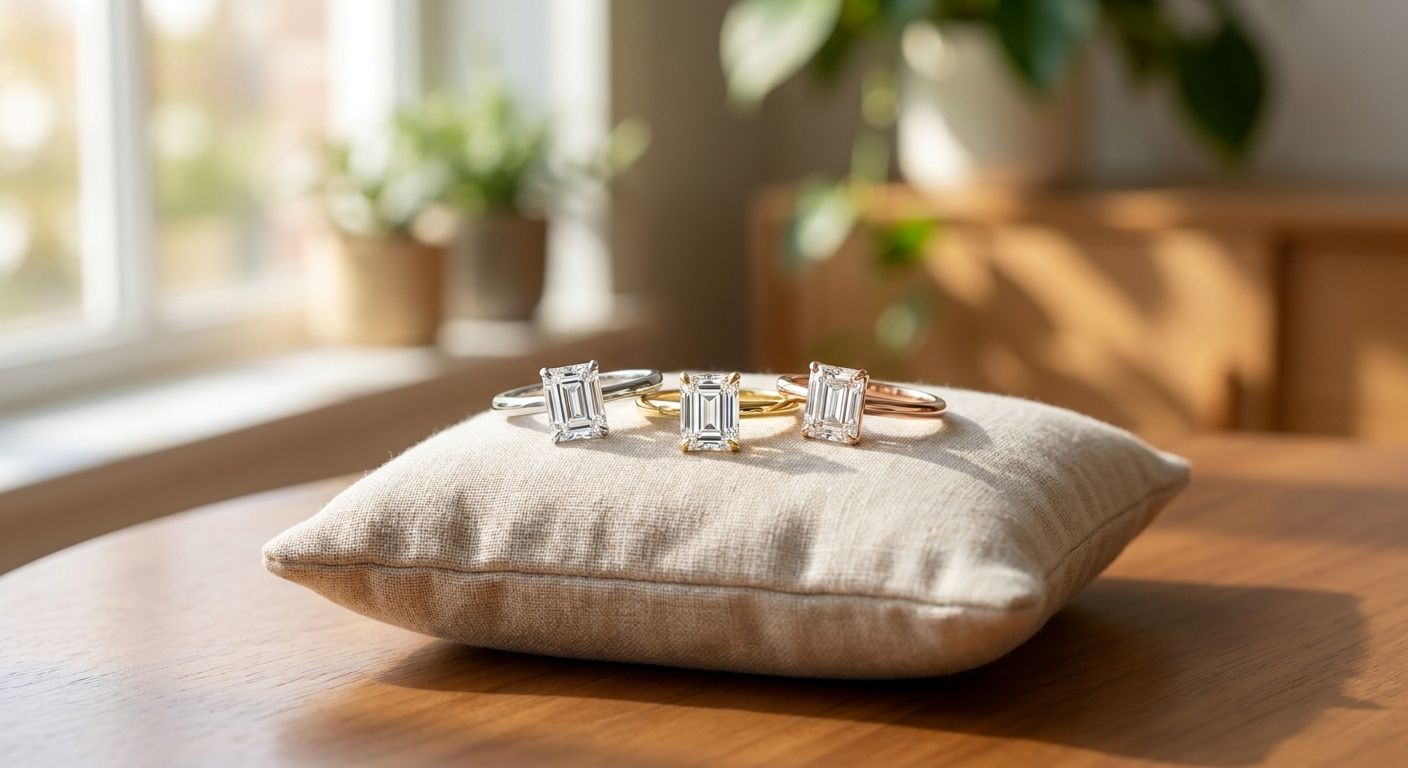
Best Emerald Cut Engagement Ring 2026: Top Setting Picks
Emerald cut engagement rings are having a real moment in 2026, and the setting you pick matters more for this shape than almost any other. The hidden halo solitaire setting wins overall for emerald cut diamonds in 2026 because it adds perceived size without inflating the carat-weight price tag, while a three-stone trillion setting wins for anyone chasing more sparkle out of a shape that's naturally low-brilliance.
- Hidden halo setting is the best emerald cut engagement ring pick overall in 2026 for size without extra carat cost.
- Three-stone trillion setting wins for buyers who want more fire from a step-cut stone.
- Lab-grown diamond engagement rings average $2,800 in 2026, with a $1,200-$6,000 range.
- Aim for a 1.30-1.50 length-to-width ratio and VS1 clarity or better on any emerald cut.
Why this matters
An emerald cut is a step cut, not a brilliant cut, so it shows off clarity and color instead of hiding flaws behind extra facets. That changes how you should shop compared to a round or oval stone, and it changes which setting actually earns its keep.
Buyers who pick an emerald cut without adjusting their clarity and setting priorities often end up with a stone that looks smaller or flatter than they expected. Get the setting right, though, and an emerald cut engagement ring reads as one of the most elegant options in the made-to-order lab-grown diamond catalog for 2026.
What makes the best emerald cut engagement ring
- Length-to-width ratio: 1.30-1.50 is the range most buyers land on for a classic, balanced emerald cut silhouette.
- Clarity grade: VS1 or higher is the practical floor, since the open step-cut facets show inclusions that a round brilliant would hide.
- Setting protection: emerald cut corners are more exposed than a rounded shape, so prong placement at the corners matters.
- Certification: IGI or GIA paperwork on the exact stone, not a lab-average estimate.
- Brilliance trade-off: step cuts flash less fire than brilliant cuts, so setting choice can compensate or work against that.
- Budget fit: emerald cut stones often face up larger per carat than round stones of the same weight, which changes the math on carat versus setting spend.
Emerald cut settings at a glance
| Setting | Best for | Standout feature | Key limitation |
|---|---|---|---|
| Hidden halo solitaire | Bigger-looking stone | Hidden diamonds boost visual size | Halo is invisible from the top view |
| Three-stone trillion | Extra sparkle | Trillion side stones add brilliance | More total stones to inspect for clarity |
| Tapered pavé band solitaire | Budget-friendly start | Pavé band lowers total spend | Less protection at the corners |
| Pear-accent three-stone | Vintage-inspired profile | Elongated silhouette | Softer size illusion than a halo |
| Bezel-accented solitaire | Everyday durability | Metal rim guards the corners | Lower light return, less sparkle |
1. Hidden Halo Solitaire Setting: best emerald cut engagement ring for a bigger-looking stone
A hidden halo setting tucks small accent diamonds under the center stone, invisible from a top-down view but visible from the side. On an emerald cut, that extra sparkle at the base compensates for the shape's naturally flatter light return.
Hidden halo pros:
- Adds perceived size without paying for extra carat weight on the center stone
- Side-profile sparkle balances the step cut's lower brilliance
- Works with both classic and vintage-leaning band styles
Hidden halo cons:
- The halo effect is easy to miss unless you look from an angle
- More total diamonds means more surfaces to check for clarity consistency
Hidden halo pricing: check current pricing on the product page, since exact cost depends on the center stone carat weight and metal choice.
Best for: buyers who want a bigger-looking emerald cut on a moderate carat budget. Verdict: Buy.
2. Three-Stone Trillion Setting: best emerald cut engagement ring for added sparkle
A three-stone trillion setting flanks the center stone with two triangular side diamonds. The trillion cut is a brilliant cut, so it throws light the step-cut center stone can't, giving the whole ring more overall flash.
Three-stone trillion pros:
- Trillion side stones add fire the emerald cut center can't produce alone
- Symmetrical shape pairs cleanly with a rectangular center stone
- Reads as a complete, finished look without needing a separate wedding band stack
Three-stone trillion cons:
- Three stones to certify and inspect instead of one
- Wider profile can crowd a narrower finger
Three-stone trillion pricing: check current pricing on the product page for carat and metal combinations.
Best for: buyers who picked emerald cut for the look but miss brilliant-cut sparkle. Verdict: Buy.
3. Tapered Pavé Band Solitaire: best emerald cut engagement ring for a budget-friendly start
A tapered pavé band solitaire keeps the center stone as the only real spend, with small pavé diamonds tapering down the band for detail without a second focal point. It's the most straightforward way to get an emerald cut ring without paying for a halo or side stones.
Tapered pavé pros:
- Lowest total stone count keeps the price focused on the center diamond
- Tapered pavé adds detail without competing for attention
- Classic enough to pair with almost any wedding band later
Tapered pavé cons:
- Less structural protection at the emerald cut's exposed corners
- No size-illusion boost, so carat weight does all the visual work
Tapered pavé pricing: check current pricing on the product page, since the pavé band cost scales with total carat weight in the band.
Best for: first-time buyers prioritizing carat weight over setting extras. Verdict: Buy.
4. Pear-Accent Three-Stone Setting: best emerald cut engagement ring for a vintage-inspired profile
A three-stone setting with pear-shaped side stones stretches the ring visually and leans into an old-world, elongated look that pairs well with an emerald cut's rectangular lines. It's a softer alternative to the trillion three-stone if you want romance over raw sparkle.
Pear-accent pros:
- Elongating side stones complement the emerald cut's rectangular shape
- Vintage styling pairs well with milgrain or filigree bands
- Distinct from the more common round or trillion three-stone combinations
Pear-accent cons:
- Doesn't add the size-illusion boost a halo provides
- Pear side stones need careful alignment or the ring looks asymmetric
Best for: buyers who want vintage character over maximum brilliance. Verdict: Hold if size illusion matters more than styling.
5. Bezel-Accented Solitaire: best emerald cut engagement ring for everyday durability
A bezel setting wraps a metal rim around part or all of the stone, which shields the emerald cut's four exposed corners from daily knocks. It trades some brilliance for peace of mind, since a full metal rim blocks light from entering the sides of the stone.
Bezel-accented pros:
- Corner protection matters more on an emerald cut than any other shape
- Lower profile catches on clothing and gloves less than prong settings
- Reads as a modern, minimal aesthetic
Bezel-accented cons:
- Noticeably less brilliance than an open four-prong setting
- Harder to clean around a full bezel rim
Best for: buyers whose hands are active daily and durability outranks sparkle. Verdict: Wait and see the stone in person before committing if brilliance matters to you.
How we ranked
Each setting was weighed against the six criteria above: ratio, clarity fit, corner protection, certification standard, brilliance trade-off, and budget fit. The hidden halo setting ranked first because it's the only option that directly compensates for both of an emerald cut's weak points — lower brilliance and lower perceived size for the carat weight — without adding cost to the center stone itself.
“An emerald cut shows every inclusion it has, so clarity grade matters more here than on any brilliant-cut shape.”
Which emerald cut engagement ring should you choose?
If you're still deciding, default to the hidden halo solitaire setting — it's the safest pick for anyone buying their first emerald cut lab-grown diamond engagement ring in 2026, and it gives you the most visual size for the carat weight you're paying for. Step up to the three-stone trillion setting only if brilliance matters more to you than a clean, minimal profile. Every setting above can be built made-to-order with IGI or GIA certification, so the setting choice, not the certification, is genuinely the deciding factor.
FAQ
What's the best emerald cut engagement ring setting in 2026?
The hidden halo solitaire setting is the best overall pick in 2026 because it adds perceived size to an emerald cut without increasing the center stone's carat weight or cost. Three-stone trillion settings are a strong second choice for buyers who want more sparkle.
Is an emerald cut engagement ring more affordable than round?
Emerald cut diamonds often cost less per carat than round diamonds of the same weight, but they face up larger, so the visual size-to-cost ratio can favor emerald cut. Lab-grown diamond engagement rings overall average $2,800 in 2026, ranging $1,200-$6,000.
What clarity grade should I choose for an emerald cut diamond?
VS1 or higher is the practical minimum for an emerald cut, since its open step-cut facets show inclusions that a round brilliant would hide. Going below VS1 risks visible flaws under normal lighting.
What's a good length-to-width ratio for an emerald cut diamond?
Most buyers land on a 1.30-1.50 length-to-width ratio for a balanced, classic emerald cut silhouette. Ratios outside that range start to look either too square or too narrow.
Can an emerald cut diamond go in a hidden halo setting?
Yes, a hidden halo setting works well with an emerald cut center stone and is one of the most effective ways to boost perceived size. The halo sits underneath the center stone, invisible from a top-down view.
Is an emerald cut diamond good for everyday wear?
An emerald cut can handle everyday wear, but its four exposed corners are more vulnerable to chips than a rounded shape. A bezel-accented or well-pronged setting reduces that risk significantly.
IGI or GIA certification for a lab-grown emerald cut diamond?
Both IGI and GIA certify lab-grown diamonds accurately, and either is acceptable as long as the certificate matches the exact stone you're buying, not a lab average. Ask for the report before finalizing any setting choice.
How much does a lab-grown emerald cut engagement ring cost in 2026?
Lab-grown diamond engagement rings average $2,800 in 2026, with most buyers spending between $1,200 and $6,000 depending on carat weight, setting, and metal choice. Emerald cut center stones can shift that range slightly since they face up larger per carat.
One last thing
Most buyers spend all their attention on the center stone and none on the corners, but on an emerald cut, the corners are the actual risk point. Ask specifically how the prongs or bezel treat the four corners before you finalize a setting, since that detail affects durability more than carat weight or clarity ever will.
For a full breakdown of what drives cost across carat, clarity, and setting choice in 2026, the lab-grown diamond ring cost guide covers the per-carat math in more detail than any single ring page can.