


The Raul Journal· Wedding Bands
How to match a wedding band to an engagement ring
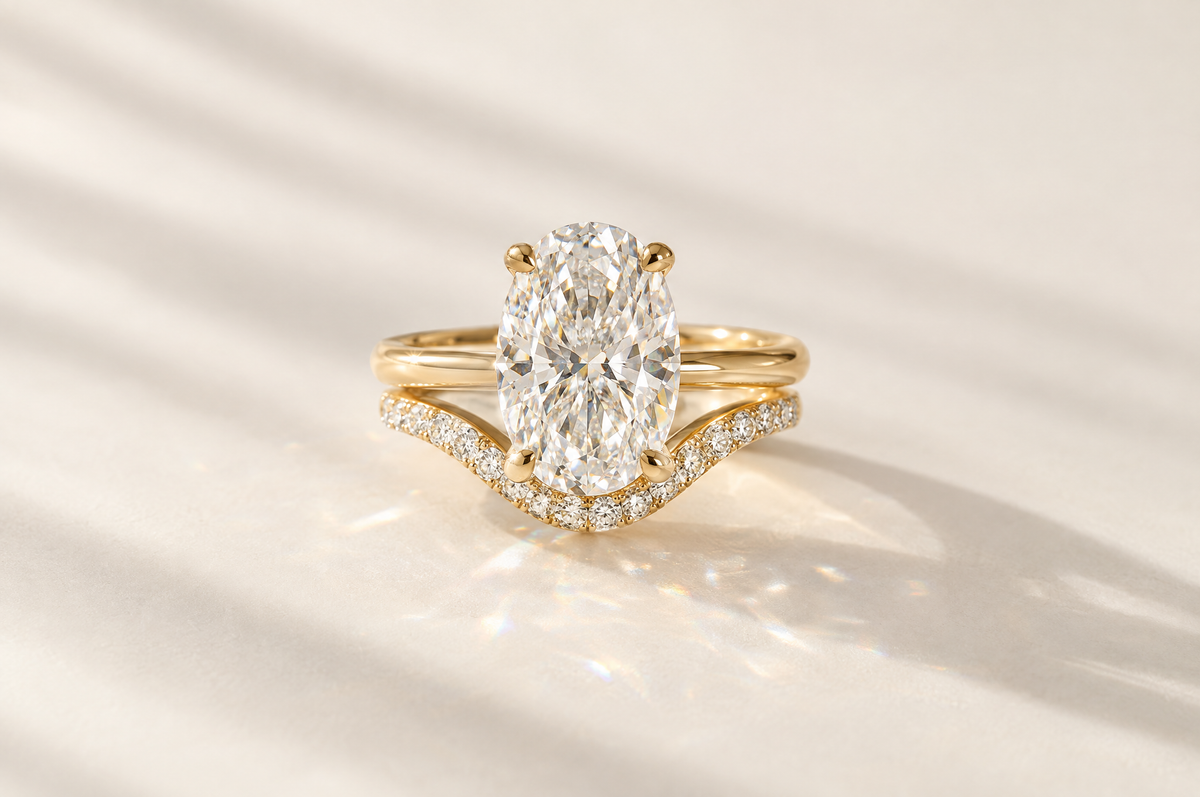
The short answer: Knowing how to match a wedding band to an engagement ring starts with the setting. Check its shape and height, then choose a band that either sits flush against it or follows its outline. Match the gold color and karat, keep the band's width in proportion, and choose between a seamless stack and a little space between the two.
Learning how to match a wedding band to an engagement ring is mostly about one thing: how the two rings meet. A band that looks lovely on its own can leave an awkward gap, rub against a setting, or overpower a delicate solitaire. This guide covers flush and gap fits, curved and contour bands, eternity choices, metal and karat, stacking, and bridal sets.
How to match a wedding band to an engagement ring: start with the setting
Before you look at bands, look at your engagement ring from the side. Three things decide what will sit well next to it:
- Height of the setting. A center diamond set high, with open space beneath, often lets a straight band slide underneath and sit flush. A low setting, a bezel or a basket that reaches down to the finger usually pushes a straight band away.
- Width of the head. Halos, hidden halos and three stone rings spread wider than a solitaire. The wider the head, the more likely a straight band will leave a gap.
- Shape of the center. Pear, marquise and elongated shapes create an outline a curved band can follow. Round and cushion shapes sit happily beside straight or gently curved bands.
Bring your engagement ring to every comparison, even a video consultation. Bands are much easier to judge beside the ring they will live with.
Flush fit or a small gap
Some people want the two rings to touch along their full length. Others like a small, intentional space. Neither is wrong; it is a style choice.
| Band type | How it sits | Best with | Feel |
|---|---|---|---|
| Straight band | Flush if the setting allows, otherwise a small gap | Higher-set solitaires and cathedral settings | Classic, clean |
| Curved or contour band | Bends around the center stone to close the gap | Halos, pear and marquise centers, three stone rings | Tailored, seamless |
| Chevron or V-shaped band | Points toward the center stone | Pear, marquise, oval and round centers | Graphic, modern |
| Open cuff or gap band | Leaves deliberate space around the center | Most settings, including wide heads | Light, contemporary |
A small gap has one quiet advantage: it can let a high setting and a straight band sit together without rubbing. If your rings touch, check the setting during routine cleaning, since two hard surfaces rubbing over time can show wear.
Curved and contour bands for halos, pears and three stone rings
A curved wedding band, also called a contour or nesting band, follows the outline of the engagement ring's center. It closes the gap so the two rings read as one piece. It is the most natural answer when a straight band leaves space you do not like.
Look for a curve that mirrors your center shape. A soft curve suits round, oval and cushion centers. A sharper V suits pear and marquise centers, where the band can echo the point. If your engagement ring has a halo, measure how far the halo reaches before you choose a curve. Browse our curved and contour wedding bands, including the Curved Contour Chevron Lab Grown Diamond Wedding Band.
Eternity or half eternity
Diamond bands come in two main forms, and the difference matters for comfort and sizing.
- Full eternity bands have diamonds all the way around. They sparkle from every angle, even when the ring turns on the finger. The trade-off: eternity bands can only be resized in a limited way, so measure carefully. Explore eternity bands.
- Half eternity bands carry diamonds across the top only. The plain lower half sits more comfortably between fingers and is simpler to resize. Explore half eternity bands.
Match the diamond setting too. Shared prong bands pair naturally with prong-set engagement rings. Channel and bezel bands pair with bezel and low-profile designs. Pavé bands pair with pavé shanks.
Match the metal and the karat
The simplest rule: wear the same gold color and the same karat in both rings.
- Color. Yellow, white and rose gold each read differently, and mixing them is a deliberate look rather than a default. If you love mixed metals, choose it on purpose and repeat it across your stack.
- Karat. 14K gold is 58.3% gold and 18K gold is 75% gold. Side by side, 18K yellow and rose look richer and deeper than 14K. Matching the karat keeps the tone even.
- Wear. Two rings worn together wear against each other, so a similar hardness helps them age evenly. 14K is the harder of the two alloys.
- White gold care. White gold is rhodium plated. Re-plate both rings at the same time, often every year or two depending on wear, so they stay the same bright white.
Our metal guide covers each option in more detail.
Stacking and bridal sets
Bridal sets pair an engagement ring and a wedding band designed together, so the fit and style are settled from the start. They are the easiest route if you are choosing both rings at once. See our bridal sets.
Stacking is for those who want to build over time. Start with your engagement ring and wedding band, then add an anniversary band or a plain gold ring later. A few principles keep a stack calm:
- Keep one ring as the focal point, usually the engagement ring.
- Mix textures rather than adding more of the same: a pavé band beside a plain twisted band, for example.
- Keep the total width comfortable. Bands wider than 6 mm call for half a size up, and a wide stack can behave the same way.
Start with our stackable wedding bands or the full range of women's wedding bands.
Our picks
Prices are from our current collection at the time of writing (October 2026).
- Curved Contoured Nesting Wedding Band in 14K Gold: a plain gold curve that nests around many center stones, from $721.
- Round Lab Grown Diamond Pavé Half Eternity Band: sparkle across the top with a comfortable plain underside, from $690.
- Classic Round Lab Grown Diamond Shared Prong Eternity Wedding Band: diamonds all the way around for prong-set engagement rings, from $1,088.
- Open Cuff Lab Grown Diamond Gap Wedding Band: a deliberate opening that works around wider settings, from $589.
- Round Lab-Grown Diamond Bridal Set in 14K Gold: engagement ring and band chosen together, from $2,468.
Questions
Does my wedding band have to match my engagement ring?
No, but they should feel related. When people ask us how to match a wedding band to an engagement ring, we start with the metal. Matching the gold color and karat does most of the work. The band's style can contrast as long as the proportions feel balanced.
Why does my straight band leave a gap?
The engagement ring's setting sits low or spreads wide, so the band cannot slide underneath. A curved or contour band closes the gap; a gap band makes the space intentional.
Is a full eternity band a good wedding band?
Yes, if you are confident in your size. Full eternity bands sparkle all the way around, but they can only be resized in a limited way. A half eternity band is simpler to resize.
Should my band be the same width as my engagement ring?
Close in width usually looks most balanced. A band much wider than the engagement ring's shank can overpower the center diamond.
What if the band does not fit well?
You can return unworn pieces within 30 days of delivery in original packaging, and you get one free resize within 60 days of delivery. Engraved and custom pieces are final sale unless defective.
If you would like a second opinion on how to match a wedding band to an engagement ring you already own, book a free 30-minute consultation. Show us your engagement ring on video and we will suggest bands that suit it.
More from the Journal.
Are lab-grown diamonds real? What they are, and how to tell
A lab-grown diamond has the same carbon crystal, hardness and sparkle as a mined diamond; only its origin differs. Here is how it compares to mined diamonds and simulants, how labs identify...
Bezel engagement rings: the modern setting, explained
A guide to bezel engagement rings: how the setting works, full versus half bezel, how it compares with prongs, which shapes suit it, and how it stacks with a wedding band.
Toi et moi engagement rings: how to choose two stones that belong together
A guide to toi et moi engagement rings: the meaning, how to pair shapes and sizes, how carat weight is listed, and how a two stone ring wears with a wedding band.
Talk it through with our team.
A free 30-minute video or phone consultation, at your pace.