


The Raul Journal· Engagement Rings
Toi et moi engagement rings: how to choose two stones that belong together
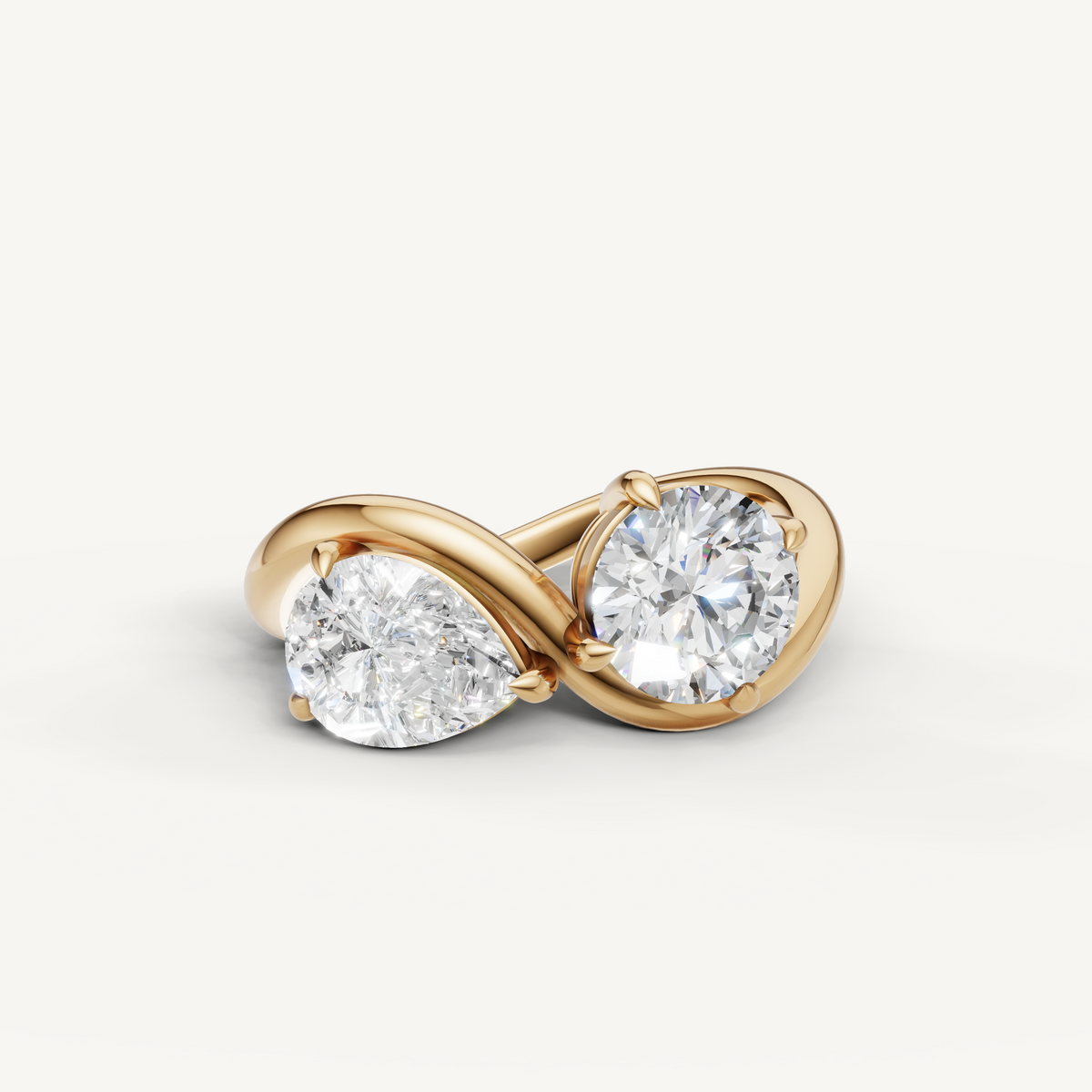
The short answer: A toi et moi engagement ring sets two diamonds side by side, and the name is French for "you and me." To choose two stones that belong together, decide first between a matched pair of equal size and a main stone with a smaller partner, then pair shapes that contrast in outline but share a similar color and brightness. A round with a pear, an emerald with a marquise, and two equal rounds are the most balanced starting points.
A toi et moi ring tells a story before anyone asks about it. This guide covers what the name means, where the style comes from, how to pair shapes and sizes, how carat weight is listed, and how a two-stone ring wears day to day and alongside a wedding band.
- "Toi et moi" means "you and me" in French; the style places two stones together, one for each partner.
- Pairs fall into two families: two stones of equal weight, or a main stone with a smaller second stone.
- On Raul Diamonds two-equal-stone styles, the carat option is the total split evenly, so 2 ct means two 1.00 ct diamonds, and both carry IGI reports.
- Most toi et moi rings sit best with a curved or contoured wedding band that follows the two stones.
What does toi et moi mean?
Toi et moi means "you and me" in French, and in jewelry it describes a ring that sets two stones close together, often turned toward each other. Each stone stands for one person, so the design reads as a pair rather than a single centerpiece.
The idea is old. The most cited example is the ring Napoleon Bonaparte gave Josephine in 1796, which set a pear-shaped diamond beside a pear-shaped sapphire on a slim gold band and sold at auction in 2013. Today the style has moved from antique cases to modern engagement rings, often with two lab-grown diamonds instead of mixed gemstones.
You will also see it called a two stone engagement ring or a "moi et toi" ring. The meaning is the same.
Should the two stones be the same shape?
The two stones do not need to match, and many of the most striking toi et moi rings pair different shapes on purpose. The choice comes down to harmony or contrast.
Same shape pairs, such as two round brilliants, look symmetrical and calm. They read as equals, which suits a couple who sees the ring as a partnership in the most literal sense. Two equal rounds also sparkle the most evenly, since both stones share the same faceting.
Mixed shapes pair two personalities. The classic approach puts a brilliant cut, which sparkles in small flashes, beside a step cut or an elongated shape with a different outline. A round with a pear softens the look. An emerald with a marquise is more architectural, with clean step facets meeting sharp points. A heart pairing is romantic without being sweet when the second stone stays small.
Whichever you choose, the two diamonds should match closely in color and clarity so neither looks dull beside the other. At Raul Diamonds, the stones in each pair are matched at E–F color and VVS1–VVS2 clarity, so the pair reads as one piece. For an overview of how each cut behaves, see our guide to diamond shapes.
| Pair | The look | Best for |
|---|---|---|
| Round + round, equal size | Symmetrical, bright and even sparkle | A classic taste that still wants something different |
| Round + pear | Soft and fluid, the pear's point leads the eye across the finger | Romantic style and a first toi et moi |
| Emerald + marquise | Architectural, step facets beside a long brilliant cut | Modern, design-led taste and longer fingers |
| Pear + marquise | Elongated and dramatic, two points in motion | Someone who wants the ring to look long and slim |
| Pear + baguette | A main pear with a clean, rectangular accent | Understated style with one clear focal stone |
| Heart + small partner | Romantic, with the heart clearly leading | Someone who loves the heart shape but wants restraint |
Equal stones or a main stone with an accent?
Equal stones give the ring a balanced, side-by-side look, while a main stone with a smaller partner gives it a clear focal point. Neither is more correct. It is about how you want the ring to read from across a table.
Equal pairs feel like a statement about partnership, and they spread the carat weight across two stones of the same size. A main-plus-accent ring looks closer to a solitaire at first glance, with the second stone adding asymmetry and a personal detail. Many people find the main-plus-accent style easier to wear every day, because one stone carries most of the height.
Size balance also changes the width on the finger. Two 1.00 ct ovals or rounds side by side cover more of the finger than a single 2.00 ct stone, so an equal pair often looks larger than the total weight suggests.
How is carat weight listed on a toi et moi ring?
On a toi et moi ring, the carat weight listed is usually the total of both diamonds, so it pays to check how that total splits. At Raul Diamonds, the rule depends on the style.
Two equal stones. On our two-equal-stone styles, the "Diamond Carat" option is the total, split evenly between the two diamonds. A 2 ct ring holds two 1.00 ct diamonds, and both are IGI certified, each with its own report.
Main stone with a second stone. These styles list a base size for the pair. Our Heart toi et moi is 1.20 ct total at its base size: a 1.00 ct main heart with 0.20 ct in smaller heart diamonds. Our Pear and baguette toi et moi is 1.80 ct total: a 1.50 ct pear with a 0.30 ct baguette.
The split matters for two reasons. It tells you how large each diamond looks, and it tells you which stones come with reports. Our certification line covers it: IGI-certified center diamonds, 1.00 ct and above. GIA available on request for custom orders. Smaller second stones are hand-selected lab-grown diamonds without individual reports. Our IGI report guide explains what each report lists.
How does a toi et moi ring sit with a wedding band?
A toi et moi ring usually sits best with a curved or contoured band that follows the outline of the two stones, or with an open band that leaves space between the rings. A straight band often leaves a gap because two stones spread wider than one.
Many toi et moi rings use a bypass design, where the band splits and wraps past each stone rather than meeting in a single point. Bypass rings look beautiful alone and can sit flush against a band shaped to match the curve. Our curved and contour wedding bands are designed for this, and our guide on how to match a wedding band to an engagement ring walks through the options.
Some people choose to wear the toi et moi ring alone and move a straight band to the other hand, or stack a thin band with a little space between them. Try a few combinations before you decide.
Is a toi et moi ring practical for everyday wear?
A toi et moi ring is practical for everyday wear when the setting protects the stones' points and keeps the profile reasonably low. Pay attention to three details.
Snagging. Bypass and open designs place stones at the edges of the ring, where they can catch on knit sweaters or hair. A lower setting and smooth prongs reduce this. If you work with your hands, a main-plus-accent ring with a small second stone tends to sit closer to the finger.
Points. Pear and marquise diamonds have fine points, the thinnest and most vulnerable parts of the stone. V-prongs, which wrap each point in metal, protect them from chips. Ask about point protection on any ring with a pear, marquise or heart.
Cleaning. Two stones mean two places for lotion and soap to collect. Soak the ring in warm water with mild dish soap and brush gently under each stone with a soft toothbrush every week or two.
Our picks
- Round & Pear Lab-Grown Diamond Toi et Moi Ring in 14K Gold: a round and a pear in a bypass design, the most balanced mixed pair, with both diamonds graded by IGI.
- Twin Round Brilliant Lab-Grown Diamond Toi et Moi Ring: two equal round brilliants for even, symmetrical sparkle.
- Lab-Grown Emerald and Marquise Cut Diamond Toi et Moi Ring in 14K Gold: step cut meets brilliant cut, for a crisp, architectural pair.
- Pear & Baguette Lab-Grown Diamond Toi et Moi Engagement Ring: a 1.50 ct pear leads, with a clean baguette at its side.
- Heart Lab Grown Diamond Toi et Moi Engagement Ring in 14K Gold: a 1.00 ct heart in a bezel setting, romantic and well protected.
See every pairing in our toi et moi rings collection.
Questions
What does toi et moi mean on a ring?
Toi et moi is French for "you and me." On a ring, it means two stones set side by side, one representing each partner, often turned slightly toward each other.
Is a toi et moi ring an engagement ring?
Yes, a toi et moi ring works as an engagement ring and has been used that way for centuries. Napoleon gave Josephine a two-stone ring in 1796, and today many couples choose two lab-grown diamonds in this style.
Do both diamonds in a toi et moi ring come with reports?
It depends on the size of each stone. On Raul Diamonds two-equal-stone styles, both diamonds are IGI certified. On main-plus-accent styles, the main stone of 1.00 ct or more has an IGI report, and the smaller stone is a hand-selected lab-grown diamond.
Which shapes look best together in a toi et moi?
Round with pear and emerald with marquise are the most popular pairings, because each combines contrasting outlines with similar brightness. Two equal rounds suit someone who prefers symmetry.
What wedding band goes with a toi et moi ring?
A curved or contoured band that follows the shape of the two stones usually fits best. You can also leave space between the rings or wear the band on the other hand.
Do toi et moi rings snag?
Bypass and open designs can catch on fabric because the stones sit at the edges. A lower setting, smooth prongs and V-prongs on pointed shapes help the ring wear comfortably every day.
Pairing two stones is personal, and it helps to see the options side by side. Book a free consultation by video or phone, and we will show you pairs, profiles and band matches before you decide.
More from the Journal.
Are lab-grown diamonds real? What they are, and how to tell
A lab-grown diamond has the same carbon crystal, hardness and sparkle as a mined diamond; only its origin differs. Here is how it compares to mined diamonds and simulants, how labs identify...
Bezel engagement rings: the modern setting, explained
A guide to bezel engagement rings: how the setting works, full versus half bezel, how it compares with prongs, which shapes suit it, and how it stacks with a wedding band.
Christmas proposal ideas, and the ring timeline that makes them work
Twelve Christmas proposal ideas that feel personal, and a week-by-week timeline for ordering a made-to-order engagement ring in time for the holidays.
Talk it through with our team.
A free 30-minute video or phone consultation, at your pace.